
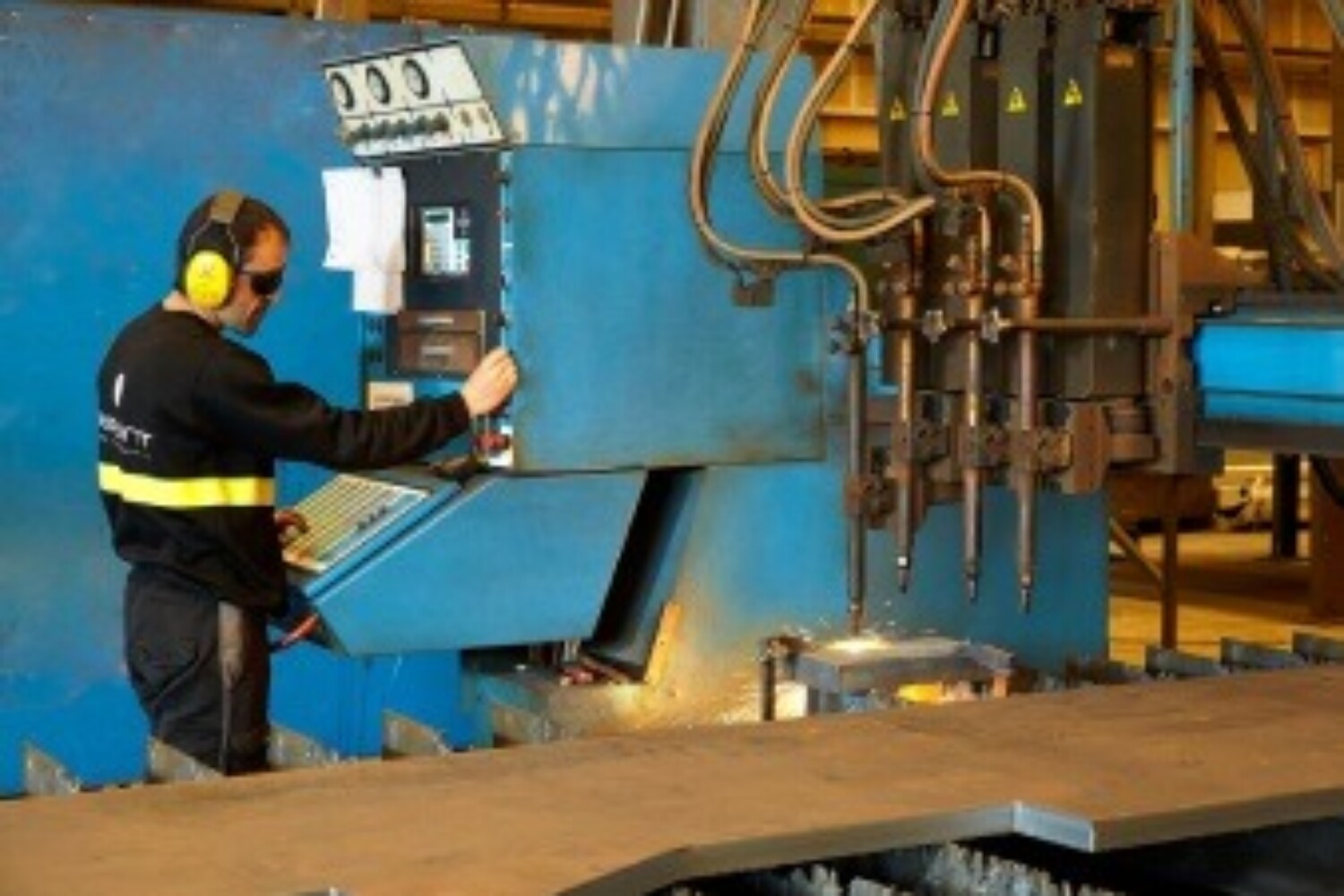
Oxy-fuel cutting is an auxiliary welding process through which we solve the cutting of metal parts through local combustion and a continuous stream of oxygen.
In the atmosphere, at room temperature and under normal conditions, steel undergoes a non-combustible and slow oxidation process, because the proportion of oxygen in the atmosphere is approximately 20%. However, if this oxidation is carried out at a temperature that reaches the combustion of the steel (approximately 870º) and under an atmosphere of oxygen (greater than 88%), said oxidation becomes combustible.
Therefore, in order for us to apply oxy-fuel cutting of the metal, we must heat (oxidize) under a suitable atmosphere (a projection of pure oxygen), thus achieving a “violent” burning that gives rise to oxy-fuel cutting.
Oxy-fuel cutting has very good application in low alloy steels and carbon steels.
Necessary conditions for oxy-fuel cutting
Below, we list the necessary conditions for us to carry out the oxy-fuel cutting process:
- We must ignite the metal in the presence of oxygen.
- The melting temperature must be higher than the ignition temperature of the metal.
- The oxide produced must have a lower melting point than that of the metal.
- Finally, we must dislodge the oxide by means of the oxygen jet.
From these conditions for the oxy-fuel cutting process to take place, we can deduce that said process is not a fusion, but a combustion. Therefore, the content of additives and other elements to the steel are truly important for the oxy-fuel cutting process, since the combustion capacity of the steel is substantially modified.
For this reason, we cannot apply oxy-fuel cutting to all metals. On the one hand, stainless steels or castings can only be cut with oxy-fuel cutting if we use filler rods that generate combustion. On the other hand, low alloy steels or carbon steels are ideal for applying oxy-fuel cutting.
Aluminum cannot be processed through oxy-fuel cutting because the oxide produced has a melting temperature of 1000º C, higher than the melting point of aluminum (660ºC).
The oxy-fuel cutting process
Next, we will describe what this cutting process consists of:
The process using oxy-fuel cutting starts with preheating through a torch that, using the fuel gas and a part of oxygen, generates a flame composed of a perimeter ring in the cutting nozzle.
We bring the preheating flame to the part, heating it until it reaches the combustion temperature (at about 870º). We know that the part reaches this temperature because the steel acquires a bright orange hue.
Once we reach the ignition temperature in the part, we act on the torch with the aim of allowing the pure oxygen jet to exit through the central hole of the nozzle, managing to enrich the atmosphere surrounding the preheated part with oxygen and, through the preheating flame, give rise to combustion.
As in any combustion, the oxidation of the steel consists of a highly exothermic reaction and it is precisely all that released energy that has the role of acting as an initiating agent in the adjacent areas, bringing them to the ignition temperature and giving continuity to the cutting process.
Subsequently, the oxide resulting from the combustion flows through the cutting groove while, simultaneously, the temperature of the walls increases, thus helping to maintain the process.
It will be when the physical action of the oxygen jet contributes to evacuating the part of the steel from the part and the molten oxide, originating the cutting groove.
What makes oxy-fuel cutting possible is that the oxides of the steel property melt at a lower temperature than that of the base metal. This is an intrinsic property of steel, since the vast majority of metals melt at lower temperatures than their oxides, so they cannot be treated by this process.
Do not hesitate to contact us if you are interested in our expert oxy-fuel cutting service.